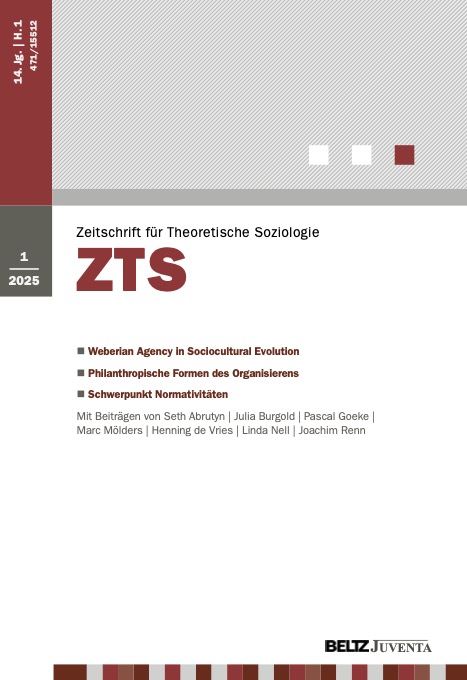
Weberian Agency in Sociocultural Evolution
Entrepreneurship, Assemblages, and Differentiation
DOI:
https://doi.org/10.17879/zts-2025-9706Schlagworte:
New Evolutionary Sociology, Max Weber, Sociocultural Evolution, Cultural SociologyAbstract
Recently, New Evolutionary Sociology (NES) has proposed three sociological forms of selection pressure: Spencerian, Durkheimian, and Marxian. While the specification of these selection processes represent a major advance, the question of how and why deliberate, purposeful sociocultural transformation occurs remains open. To address this gap, this paper suggests adding insights from Weber’s work on carrier groups, working out a Weberian theory of selection in two moves. First, Weber’s carrier groups are better candidates than memes to be the sociocultural analogy to genes. Carrier groups develop, protect, and propagate cultural assemblages that consist of world views, material/ideal interests, and an ethic, with carrier groups and their assemblages being the Weberian units of selection. Second, Weber’s historical sociology suggests three phases of sociocultural evolution that highlights the diversity of selection processes and measures of success: (1) a foundational stage in which carriers act like mutations, (2) a diffusion stage where carriers emulate gene flow, and (3) a sedimentation stage where carriers institutionalize their assemblages. After delineating a Weberian selection process, implications for NES, cultural sociology, and sociology’s conventional historiography are addressed.
Downloads
Veröffentlicht
Zitationsvorschlag
Ausgabe
Rubrik
Lizenz
Copyright (c) 2026 Zeitschrift für Theoretische Soziologie

Dieses Werk steht unter der Lizenz Creative Commons Namensnennung - Weitergabe unter gleichen Bedingungen 4.0 International.