Neo-materialistische Bewegungen in der Transformation von Ernährungssystemen: Dynamiken zwischen Nachbarschaft und Wertschöpfungskette
DOI:
https://doi.org/10.17879/sun-2026-10398Keywords:
Ernährungsräte, Soziale Bewegungen, sozial-ökologische Transformation, organising, doability, InfrastrukturAbstract
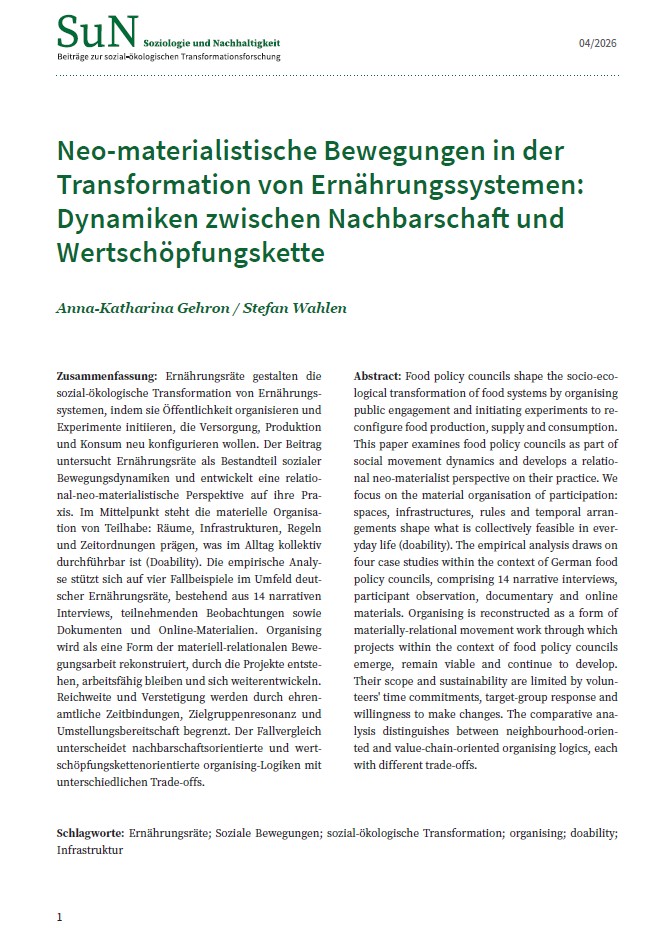
Food policy councils shape the socio-ecological transformation of food systems by organising public engagement and initiating experiments to reconfigure food production, supply and consumption. This paper examines food policy councils as part of social movement dynamics and develops a relational neo-materialist perspective on their practice. We focus on the material organisation of participation: spaces, infrastructures, rules and temporal arrangements shape what is collectively feasible in everyday life (doability). The empirical analysis draws on four case studies within the context of German food policy councils, comprising 14 narrative interviews, participant observation, documentary and online materials. Organising is reconstructed as a form of materially-relational movement work through which projects within the context of food policy councils emerge, remain viable and continue to develop. Their scope and sustainability are limited by volunteers' time commitments, target-group response and willingness to make changes. The comparative analysis distinguishes between neighbourhood-oriented and value-chain-oriented organising logics, each with different trade-offs.
Downloads
Published
How to Cite
Issue
Section
License
Copyright (c) 2026 Anna-Katharina Gehron, Stefan Wahlen

This work is licensed under a Creative Commons Attribution 4.0 International License.