
Resonanz-Infrastrukturen. Zur Institutionalisierung von Resonanz in religiösen Organisationen
DOI:
https://doi.org/10.17879/sun-2026-10445Keywords:
Sozial-ökologische Transformation, Resonanztheorie, Faith-Based Organisations (FBOs), Resonanz-Infrastrukturen, NachhaltigkeitAbstract
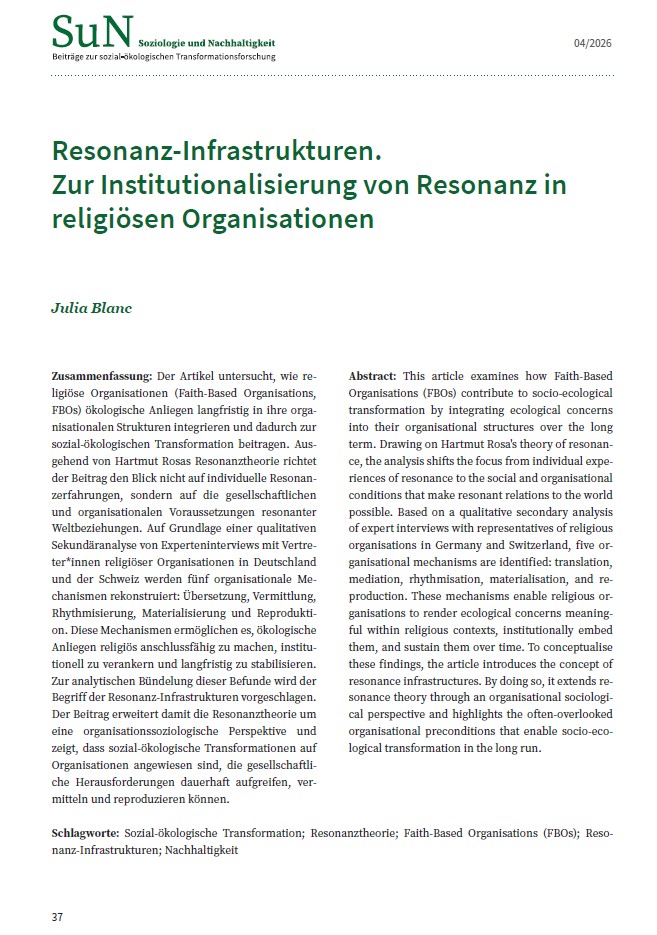
This article examines how Faith-Based Organisations (FBOs) contribute to socio-ecological transformation by integrating ecological concerns into their organisational structures over the long term. Drawing on Hartmut Rosa's theory of resonance, the analysis shifts the focus from individual experiences of resonance to the social and organisational conditions that make resonant relations to the world possible. Based on a qualitative secondary analysis of expert interviews with representatives of religious organisations in Germany and Switzerland, five organisational mechanisms are identified: translation, mediation, rhythmisation, materialisation, and reproduction. These mechanisms enable religious organisations to render ecological concerns meaningful within religious contexts, institutionally embed them, and sustain them over time. To conceptualise these findings, the article introduces the concept of resonance infrastructures. By doing so, it extends resonance theory through an organisational sociological perspective and highlights the often-overlooked organisational preconditions that enable socio-ecological transformation in the long run.
Downloads
Published
How to Cite
Issue
Section
License
Copyright (c) 2026 Julia Blanc

This work is licensed under a Creative Commons Attribution 4.0 International License.