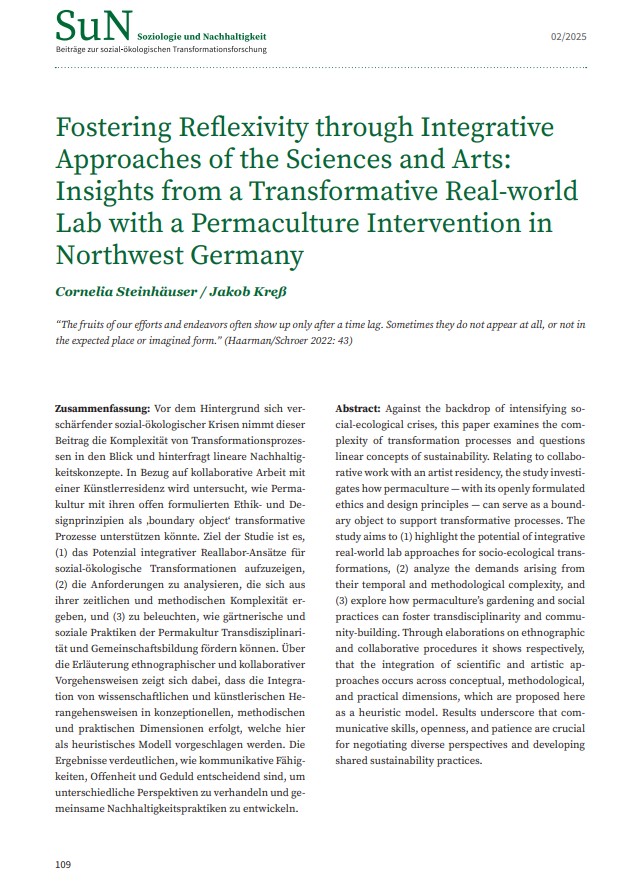
Fostering Reflexivity through Integrative Approaches of the Sciences and Arts
Insights from a Transformative Real-world Lab with a Permaculture Intervention in Northwest Germany
DOI:
https://doi.org/10.17879/sun-2025-9217Keywords:
Transformation, Permaculture, SustainabilityAbstract
Against the backdrop of intensifying social-ecological crises, this paper examines the complexity of transformation processes and questions linear concepts of sustainability. Relating to collaborative work with an artist residency, the study investigates how permaculture — with its openly formulated ethics and design principles — can serve as a boundary object to support transformative processes. The study aims to (1) highlight the potential of integrative real-world lab approaches for socio-ecological transformations, (2) analyze the demands arising from their temporal and methodological complexity, and (3) explore how permaculture's gardening and social practices can foster transdisciplinarity and community-building. Through elaborations on ethnographic and collaborative procedures it shows respectively, that the integration of scientific and artistic approaches occurs across conceptual, methodological, and practical dimensions, which are proposed here as a heuristic model. Results underscore that communicative skills, openness, and patience are crucial for negotiating diverse perspectives and developing shared sustainability practices.
Downloads
Published
How to Cite
Issue
Section
License
Copyright (c) 2025 Ana Cornelia Steinhäuser, Jakob Kreß

This work is licensed under a Creative Commons Attribution 4.0 International License.