
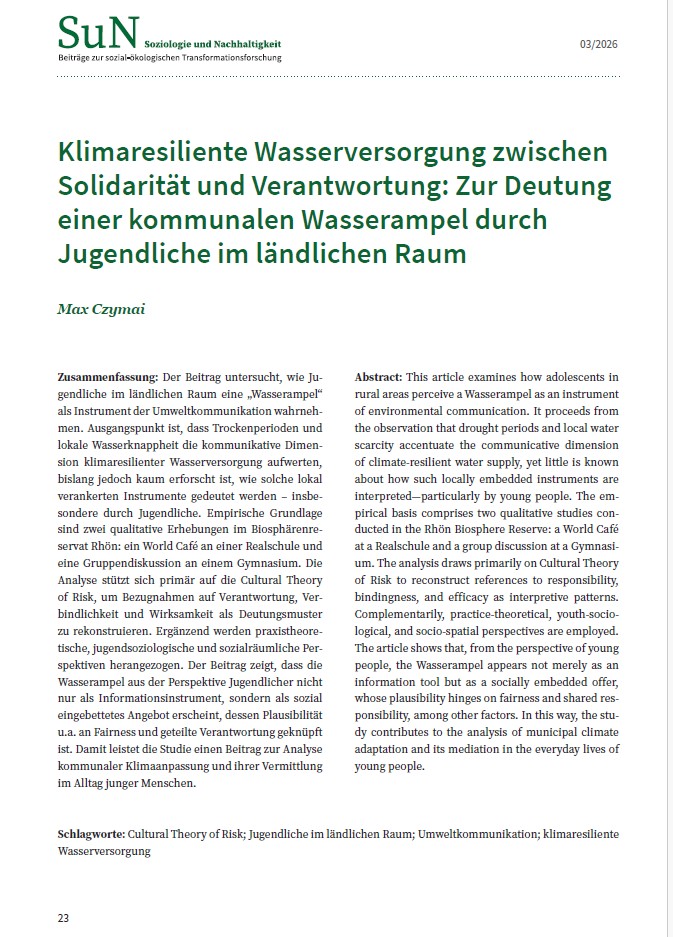
Klimaresiliente Wasserversorgung zwischen Solidarität und Verantwortung: Zur Deutung einer kommunalen Wasserampel durch Jugendliche im ländlichen Raum
DOI:
https://doi.org/10.17879/sun-2026-10249Keywords:
Cultural Theory of Risk, Jugendliche im ländlichen Raum, Umweltkommunikation, klimaresiliente WasserversorgungAbstract
This article examines how adolescents in rural areas perceive a Wasserampel as an instrument of environmental communication. It proceeds from the observation that drought periods and local water scarcity accentuate the communicative dimension of climate-resilient water supply, yet little is known about how such locally embedded instruments are interpreted—particularly by young people. The empirical basis comprises two qualitative studies conducted in the Rhön Biosphere Reserve: a World Café at a Realschule and a group discussion at a Gymnasium. The analysis draws primarily on Cultural Theory of Risk to reconstruct references to responsibility, bindingness, and efficacy as interpretive patterns. Complementarily, practice-theoretical, youth-sociological, and socio-spatial perspectives are employed. The article shows that, from the perspective of young people, the Wasserampel appears not merely as an information tool but as a socially embedded offer, whose plausibility hinges on fairness and shared responsibility, among other factors. In this way, the study contributes to the analysis of municipal climate adaptation and its mediation in the everyday lives of young people.
Downloads
Published
How to Cite
Issue
Section
License
Copyright (c) 2026 Max Czymai

This work is licensed under a Creative Commons Attribution 4.0 International License.